Battery Power Tips

  • Home
  • Markets & Applications
    • Automotive
    • Aerospace & Defense
    • Energy Management & Harvesting
    • Industrial
    • IoT
    • Medical
    • Renewables & Grid Connected
    • Robotics
    • Stationary Power
    • Wearables
  • Learn
    • eBooks/Tech Tips
    • EE Training Days
    • FAQs
    • Learning Center
    • Tech Toolboxes
    • Webinars & Digital Events
  • R&D
  • Resources
    • Design Guide Library
    • Digital Issues
    • Engineering Diversity & Inclusion
    • LEAP Awards
    • White Papers
  • Engineering Training Days
  • Advertise
  • Subscribe

EV charger reference design employs GaN for 3 kW/L power density

By akalnoskas | March 22, 2019

VisIC Technologies, Ltd announced the availability of its On-Board-Charger (OBC) reference design for the fast-growing Electrical Vehicle (EV) market. The 6.7kW OBC features a size and weight of only 2.3L and 4.5kg respectively, providing close to 3kW/L power density and proving the disruptive capability of GaN switches. This is 3 x better power density compared to commercially available products today. With the efficiency above 96% across a wide load range, it helps automotive manufacturers to reduce power losses and enables faster charging for electric car owners.
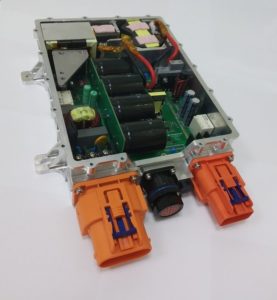
6.7kW OBC

The 6.7kW OBC features a size and weight of only 2.3L and 4.5kg respectively, providing close to 3kW/L power density and proving the disruptive capability of GaN switches. The 6.7kW OBC using VisIC GaN power devices targets plug-in hybrid vehicles/electric vehicles (PHEV/EV) applications. With a universal 110‐220V/16-32A AC input and 200‐430V DC output for charging the automotive battery by controlling voltage and current flow to the battery.
The charger is designed to provide the interfaces to charging standards on the input power side and thus adapts to charging infrastructure. The advanced OBC design which uses VisIC’s GaN technology, designed for Automotive qualification requirements AEC-Q101, demonstrates reduction in power losses, size and weight. The overall advantages include simplifying the cooling systems, reducing the charging time and reducing the size and cost of the EV.

You may also like:


  • How electric vehicle wireless charging works
  • EV charging stations
    Protecting fast EV charging stations

  • Talk of EV fires still smolders

  • EV technology goes industrial: Scenes from the Battery Show
  • battery thermal management
    EV battery thermal management challenges

  • Say goodbye to cross-country road trips


Filed Under: Applications, Automotive, Battery Management, FAQs, Featured
Tagged With: visictechnologiesltd
 

Next Article

← Previous Article
Next Article →

“battery
EXPAND YOUR KNOWLEDGE AND STAY CONNECTED
Get the latest info on technologies, tools and strategies for EE professionals.

Featured Contributions

  • Preparing for sodium-ion battery storage? Advanced simulation models can help
  • Q & A: why automation is essential for advancing EV battery manufacturing
  • Battery and charging innovations driving electrification
  • What is a lithium battery digital passport?
  • Battery testing: critical to the rise of electric vehicles
More Featured Contributions

EE TECH TOOLBOX

“ee
Tech Toolbox: Connectivity
AI and high-performance computing demand interconnects that can handle massive data throughput without bottlenecks. This Tech Toolbox explores the connector technologies enabling ML systems, from high-speed board-to-board and PCIe interfaces to in-package optical interconnects and twin-axial assemblies.

EE LEARNING CENTER

EE Learning Center

ENGINEERING TRAINING DAYS

engineering

RSS Current EDABoard.com discussions

“bills
Battery Power Tips
  • EE World Online
  • Design World
  • Medical Design & Outsourcing
  • Solar Power World
  • The Robot Report
  • Contact
  • Sign Up Enews

Copyright © 2026 WTWH Media LLC. All Rights Reserved. The material on this site may not be reproduced, distributed, transmitted, cached or otherwise used, except with the prior written permission of WTWH Media
Privacy Policy | Advertising | About Us

Search Battery Power Tips

  • Home
  • Markets & Applications
    • Automotive
    • Aerospace & Defense
    • Energy Management & Harvesting
    • Industrial
    • IoT
    • Medical
    • Renewables & Grid Connected
    • Robotics
    • Stationary Power
    • Wearables
  • Learn
    • eBooks/Tech Tips
    • EE Training Days
    • FAQs
    • Learning Center
    • Tech Toolboxes
    • Webinars & Digital Events
  • R&D
  • Resources
    • Design Guide Library
    • Digital Issues
    • Engineering Diversity & Inclusion
    • LEAP Awards
    • White Papers
  • Engineering Training Days
  • Advertise
  • Subscribe