
Infineon Technologies AG is expanding its product offering for battery management systems with a new sensing and balancing IC: the TLE9012AQU. The device is especially designed for batteries in hybrid and electric cars, but it is also suitable for other applications.
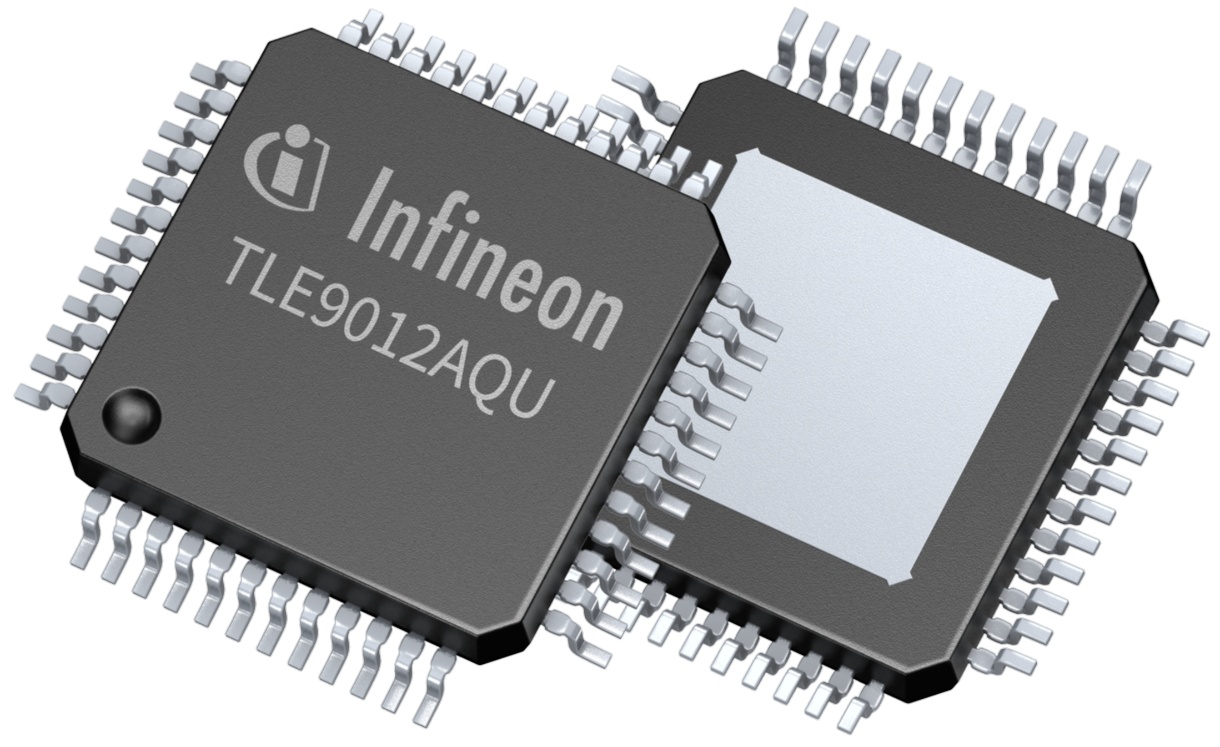 The TLE9012AQU measures the voltage in up to 12 battery cells with an accuracy of ± 5.8 mV over the entire temperature and voltage range, as well as the operating life cycle. Furthermore, it supports up to five external temperature sensors, provides an integrated cell balancing function and uses an iso-UART interface for communication.
Battery management systems (BMS) ensure, that the capacity of a battery is optimally used, so that the longest possible range is achieved in an electric car and that the battery does not age prematurely. In addition, they determine the battery’s state of charge and state of health to estimate the available range and remaining service life.
The TLE9012AQU provides the necessary measurement data and ensures a balanced state of charge through cell balancing. Among other things, this prevents the weakest cell from determining the total usable capacity of the battery.
To minimize the influence of interfering signals on the measurement results, the new sensing and balancing IC from Infineon features a programmable noise filter. Additionally, it performs the measurement in all cells simultaneously so that the results remain comparable even in the presence of temporary interference factors. A compensation algorithm with integrated stress sensor and extended temperature compensation ensures the long-term stability of the measurements.
Cell balancing is achieved via the 12 balancing switches integrated on the chip – one per channel. They are designed for currents up to 150 mA. For higher balancing currents, the device also supports external switches. The cell balancing can also be programmed to stop without a signal from the microcontroller after a defined time of up to 32 hours or when the cell has reached a defined voltage. This allows the microcontroller to switch to sleep mode and thus save energy.
With its dozen channels, the TLE9012AQU is particularly suitable for batteries that are partitioned with 12 cells per module. One device is then required per module. The iso-UART interface for data exchange between these modules and with the microcontroller allows easy voltage isolation and ensures data integrity. The communication supports more than 20 serially connected devices and a ring topology. This ensures that even if a single device fails, the communication chain is not broken and the rest of the system remains functional.