
STMicroelectronics, a global semiconductor company serving customers across the spectrum of electronics applications, is facilitating the modernization of battery-powered products to capture the advantages of the latest USB Power Delivery (USB PD) technology — including faster charging and easy reuse of USB-C chargers and cables.
 The universal fast-charging ecosystem is rapidly expanding as products like mobile handsets gain ever-larger batteries. The latest USB PD chargers can have power ratings up to 100W and can optimize charging by dynamically adjusting current and voltage thanks to the USB Programmable Power Supply (PPS) feature of USB PD.
A huge diversity of products such as smart speakers, power tools, wearables, robots, gaming controllers, power banks, and drones — typically recharged at 5V through older USB micro-B or proprietary connectors — can now leverage this ecosystem to benefit from the advantages and interoperability of USB-C technology while charging faster.
“Using our USB-IF-certified development board, customers can now quickly add all of the USB-C benefits and reuse a solid platform for certification of their own board, contributing to a safe and reliable USB Type-C and USB PD ecosystem,” said Ricardo de Sa Earp, group VP, Microcontrollers Division General Manager, STMicroelectronics.
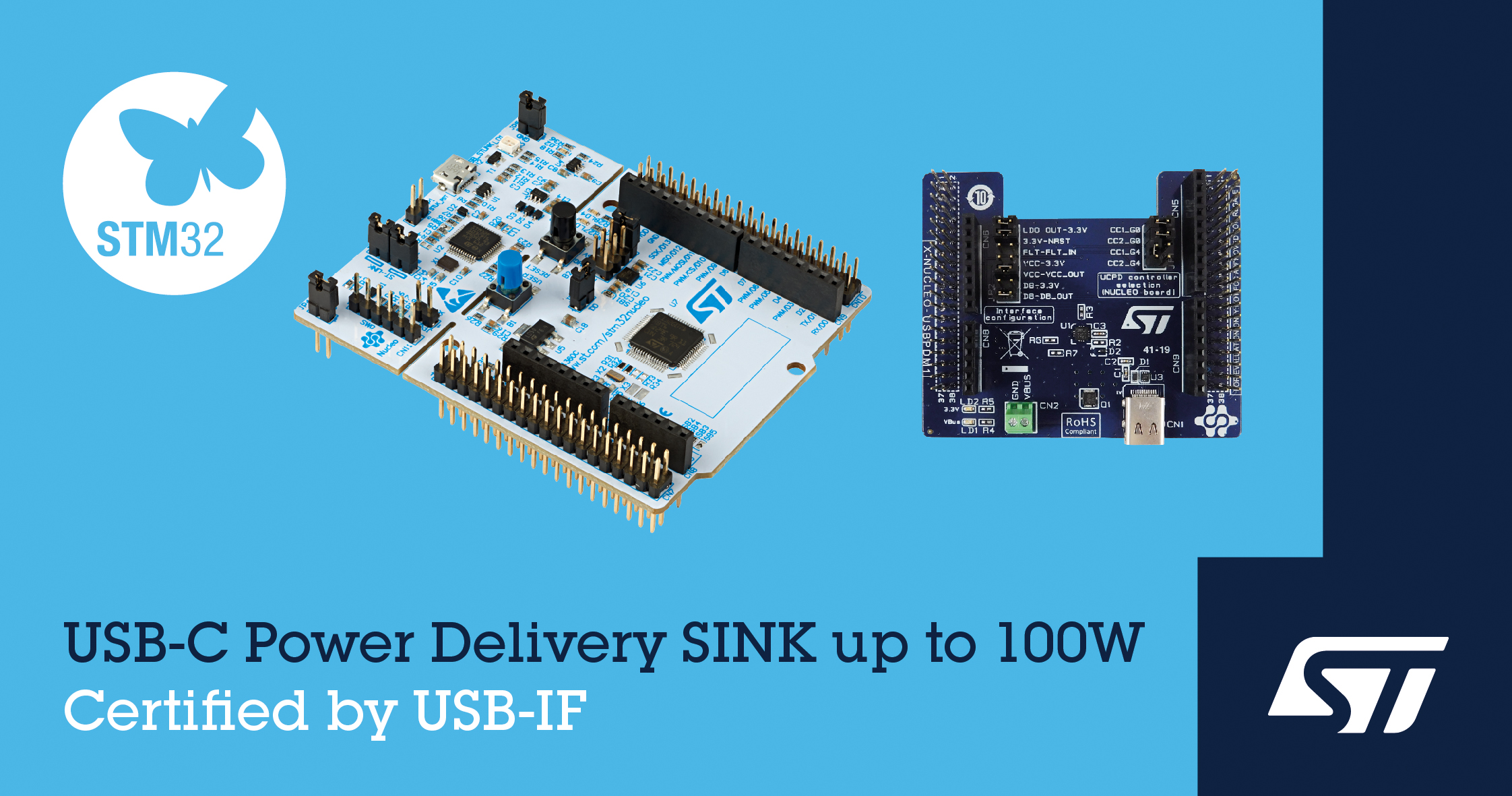
To support this migration, ST has created a USB Implementers Forum (USB-IF) certified evaluation board for up to 100W PPS USB Power Sinking Devices (PSD) that helps developers accelerate new designs and supports certification of the end product.
“The unmatched capabilities of USB PD over USB Type-C cables and connectors is driving rapid innovation in a variety of USB charging applications and markets,” said Jeff Ravencraft, USB-IF president, and COO. “Inventive solutions, such as ST’s new evaluation board, are vital to support the continued growth of USB-IF-certified USB PD and USB Type-C devices that consumers can rely on.”
The certified device (USB-IF TID: 3036) combines ST’s Nucleo-G071RB and X-Nucleo-USBPDM1 development boards. The Nucleo-G071RB features an STM32G0 microcontroller, the industry’s first general-purpose microcontroller to integrate a USB Type-C Power Delivery controller on-chip, enabling greater system integration as well as the possibility to support new application use cases. The X-Nucleo-USBPDM1 board contains ST’s TCPP01-M12 companion chip for port protection.
Moreover, customers can leverage the powerful tools and software of the STM32 ecosystem to complete their projects quickly and easily. Applications already using a microcontroller with legacy 5V USB charging can be updated to USB Type-C with only a small number of external components.
Technical info
The STM32G0 MCU and TCPP01-M12 enable an efficient and economical two-chip solution capable of controlling and protecting the USB PD capable USB Type-C port as well as hosting the embedded application.
The TCPP01-M12 companion high-voltage analog front end integrates a charge pump to control the gate of an external power switch, which lets designers choose from economical N-channel MOSFETs that have lower RDS(on) than P-channel alternatives. There is also a low-power mode that draws 0nA when no cable is attached, enabling longer battery runtime.
The protection features built into the TCPP01-M12 include adjustable 5V to 22V over-voltage protection on VBUS, short-to-VBUS protection on configuration channel pins, dead-battery management, and IEC 61000-4-2 ESD protection up to ±8kV on VBUS and CC lines. The TCPP01-M12’s QFN12 package occupies 80% less board space than a discrete implementation.