The U.S. Dept. of Energy has announced $17.9 million in funding for four research and development projects to scale American manufacturing of flow battery and long-duration storage systems. DOE also launched a new $9 million effort — the Energy Storage for Social Equity Initiative — to assist as many as 15 underserved and frontline communities leverage energy storage as a means of increasing resilience and lowering energy burdens.
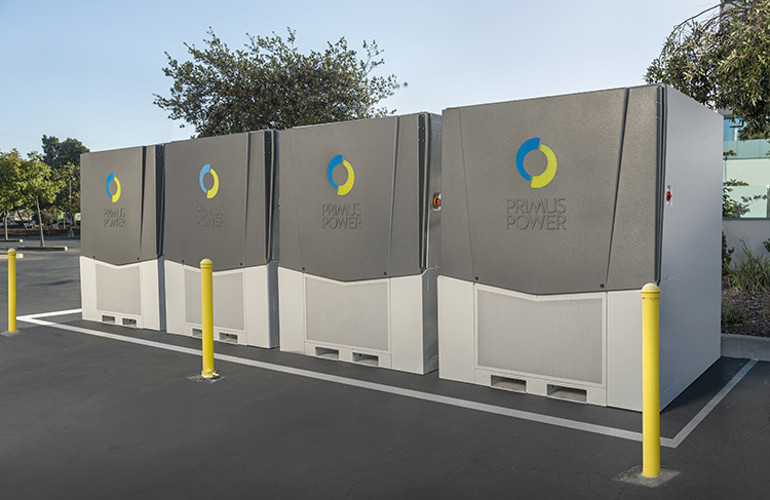
Flow battery design from Primus Power
“We’re moving at lightning speed to harness renewables and access to long duration storage is critical for dispatching this clean energy for use whenever and wherever it’s needed,” said Secretary of Energy Jennifer M. Granholm. “DOE’s investment to boost battery storage technology coupled with our first-ever Energy Storage for Social Equity Initiative will help generate jobs, build more resilient communities and ensure a cleaner, healthier environment for all Americans.”
While shorter duration storage is currently being installed to support today’s level of renewable energy generation, longer duration storage technologies – like flow batteries – are needed as more renewables are deployed on the grid. Cheaper and more efficient storage will make it easier to capture and store renewable clean energy for use when energy generation is unavailable or lower than demand.
Flow batteries are electrochemical batteries that use externally stored electrolytes, making them less expensive, safer, and more flexible and adaptable. DOE has selected four research, development, demonstration, and deployment (RDD&D) projects for a total of $17.9 million in federal funding to advance flow-battery technologies. Selected projects will work to improve manufacturing processes for individual flow battery components and integrate those new or improved components into a prototype system with a mid-sized capacity for grid and industrial applications.
This investment is part of DOE’s Energy Storage Grand Challenge and will be critical to achieving the department-wide Long Duration Storage Shot goal of reducing the cost of grid-scale energy storage by 90% within the decade.
- Largo Clean Energy and partners (Wilmington, Massachusetts) will receive $4.19 million to develop and demonstrate highly efficient manufacturing processes for affordable, grid-scale flow batteries.
- TreadStone Technologies. and partners (Princeton, New Jersey) will receive $4.99 million to develop roll-to-roll technology for manufacturing metallic electrodes and bipolar plates, which are essential components of flow batteries.
- OTORO Energy and partners (Broomfield, Colorado) will receive $4.14 million to improve the cost, scalability, and performance of existing flow battery technology through a metal chelate flow battery system.
- Quino Energy and partners (Menlo Park, California) will receive $4.58 million to strengthen the U.S. domestic flow battery manufacturing ecosystem by developing and executing a scalable, cost‐effective, and continuous process for producing aqueous organic flow battery reactants.
DOE also launched the Energy Storage for Social Equity initiative — a $9 million program designed to help communities better assess storage as a solution for increasing energy resilience while maintaining affordability and combating high energy insecurities. Nationally, more than 65% of low-income households face a high energy burden and more than 30% of all households experienced some form of energy insecurity — sometimes even foregoing food, medicine, and comfort in order to pay an energy bill.
Selected communities will gain access to DOE’s technical experts for assistance in conducting energy, economic, and spatial analysis, as well as assistance in developing and deploying locally-tailored energy storage projects.
News item from DOE